No products in the cart.
SOLD OUT! Immersive DNA Case Studies Workshop
DNA research has a way of raising more questions than it answers — until you know how to work a case systematically. Immersive DNA Case Studies is a hands-on, three-session live workshop in which real mysteries are worked through from first evaluation to conclusion, with Michelle Leonard guiding you every step of the way.
Each session builds on the last, with case studies increasing in complexity as the workshop progresses. You'll work through each stage of the investigation — evaluating the problem, identifying and analysing matches, and building toward a conclusion — with time to work on tasks yourself before coming together to discuss findings and move forward. Between sessions there is homework: some elements of DNA research take longer than workshop time allows, and the work you do in between is part of the process.
Whether you're dealing with an adoption, unknown or misattributed parentage, or any other unknown ancestor mystery, this workshop will give you the techniques to tackle it. And if you don't have a specific mystery to solve, working through real-world cases will sharpen your understanding of how to identify DNA matches and confirm your family tree.
Michelle Leonard has solved hundreds of DNA mystery cases. In this workshop, she shares that expertise directly — not through lecture, but through doing.
Details
Workshop Cost: $187 (US dollars) for 6 hours (3 sessions each of 2 hours)
When: 27 August, 3, 10 September 2026 @ 3 PM Eastern US
Where: via ZOOM. All sessions are recorded and available for viewing for 14 days following each session. A comprehensive handout is provided. Attendance is limited to 30 participants.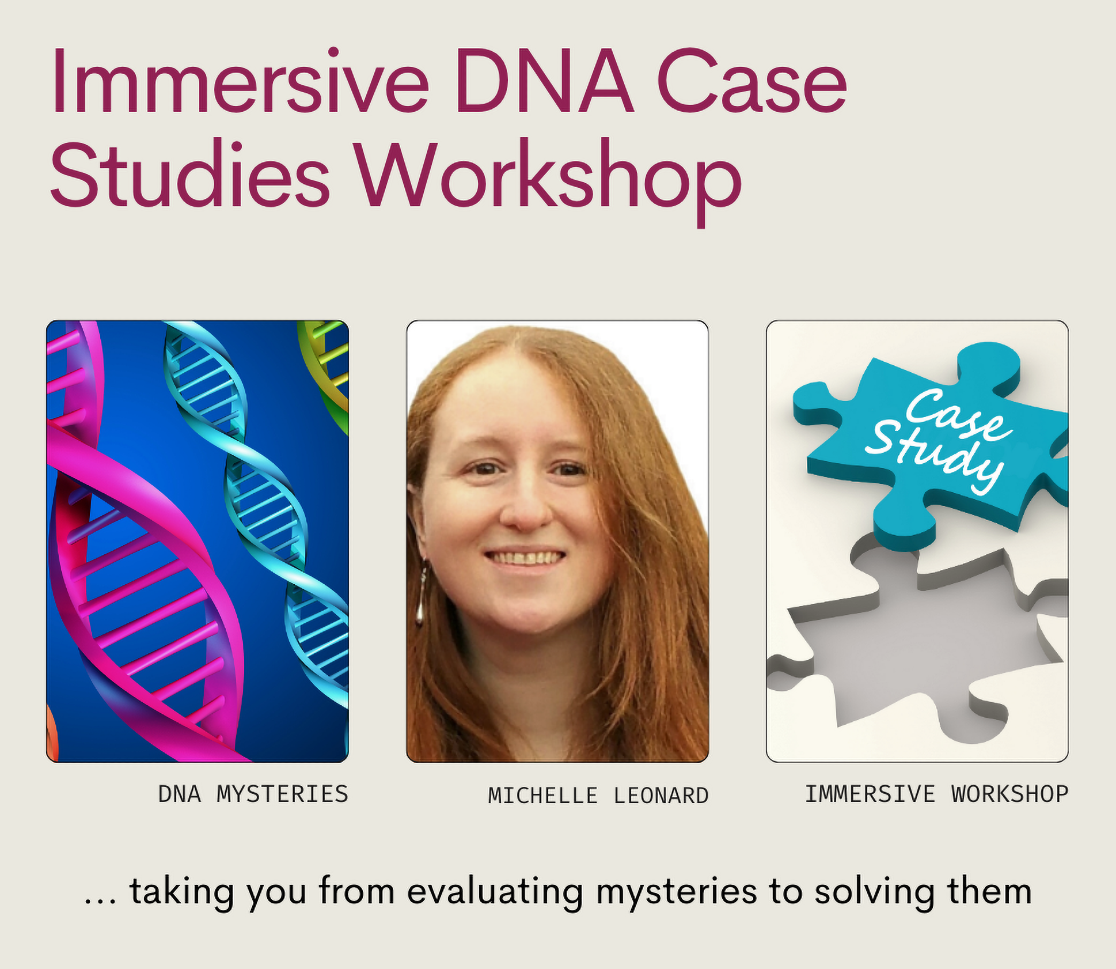
About Michelle Leonard
Genes & Genealogy
Michelle Leonard is a Scottish professional genealogist, DNA detective, freelance researcher, speaker, author and historian. She runs her own genealogy and DNA consultancy business, Genes & Genealogy, and specialises in DNA detective work particularly the solving of adoption, unknown parentage and all manner of unknown ancestor mysteries using a combination of DNA expertise and conventional research methods. She also undertakes traditional family history research, living relative tracing, historical and television research, media consultation, the creation of bespoke family history books, podcasts, article, blog and book writing, tutoring, lecturing, webinars and speaking engagements. She is a regular speaker at major genealogy events and is a co-author of Tracing Your Ancestors Using DNA: A Guide For Family Historians.
Michelle holds an M.A. in English and Modern History from the University of St Andrews and a PgCert in Genealogical, Palaeographic and Heraldic Studies from the University of Strathclyde. She is a member of the Association of Professional Genealogists (APG), the Scottish Genealogy Network (SGN) and the International Society of Genetic Genealogy (ISOGG).
You can find out more about Michelle on her Genes & Genealogy Facebook page and you can follow her on X.
Benefits for Family Historians
Learn by doing, not by watching Each session is structured around active participation — you'll work on tasks, discuss findings, and move through each case together. The goal is hands-on skill building, not passive observation.
Work on cases that reflect real research challenges The case studies are drawn from genuine mysteries (anonymised) and carefully constructed scenarios. They present the kinds of problems you're likely to encounter in your own research.
Build skills that increase in complexity The workshop is structured so that difficulty builds across all three sessions. By the time you reach the final case, you'll be working at a level that would have felt out of reach at the start.
Guided by one of the field's most experienced DNA investigators Michelle Leonard has solved hundreds of DNA mystery cases. Her expertise shapes every element of this workshop — including what to do when the evidence doesn't cooperate.

Queensland, AUSTRALIA
Copyright 2026 Family History Academy
CONTACT US